


range hood repair specialists
Smoke goes up.
Air stays clear.
The fix is ours.
Repairs for the range hood that clears the smoke.
Tell us what it does. We’ll find out why.
- Blowers, capacitors and speed switches
- Lights, filters, dampers and ducts
- Wall, under-cabinet, island, insert
What to expect
Experienced technicians
More than 12 years in appliance repair
Upfront pricing
The cost of the repair in writing, before any work begins
OEM parts on order
Original manufacturer parts ordered against your model number, never third-party substitutes
Warranty on our workmanship
Every repair is backed by a warranty on the work we performed
Your next step
to a working range hood.
A few details now.
A little less to worry about.
Tell us what the hood does
Choose the kind of hood and describe what the fan, the lights or the filters are doing.
Settle on a date
One day from the calendar, and a morning or an afternoon arrival.
The address
Street and house number, plus a phone the technician can call when on the way.
Every range hood carries a small sticker or metal label with the make, the model and the serial number. On most it sits inside the canopy, on a side wall or the back panel, where it shows once the grease filters are lifted out; on a custom insert it is inside the liner in the same place, and on a pop-up downdraft vent it is usually on the housing under the counter. A photo of that label tells us exactly which hood we are coming to.
or call (844) 398-3217
Loading appointment form…
The appointment form couldn’t load. Please try again.
Four steps,
and no surprises.
The three steps in the form are how you book. These four are what actually happens once a technician is standing in your kitchen.
Airflow, speed by speed
Each fan speed is run in turn while the technician listens to the blower and checks the pull at the filters, then the lights, the keypad, the damper and the heat sensor are tried one by one. The chimney cover and the blower housing are opened by the technician, with the breaker off.
A figure before any work
You hear what failed and what fixing it comes to in the same conversation, then choose. When a new hood makes more sense than the part, the technician tells you so directly.
Common parts in the van
Run capacitors, speed switches, bulbs and LED modules, light drivers, damper flaps and some filters usually travel with us. A blower assembly, a control board, a keypad or a remote blower is made for one model and gets ordered; if the model number comes with the booking, the order can go in before the visit.
Pulling steam before we go
With the part fitted and the covers back on, a pot is brought to the boil and the steam is watched going up into the hood on every speed, the damper is checked for a clean open and close, and the hood is handed back to you working.
Not every range hood
breaks the same way.
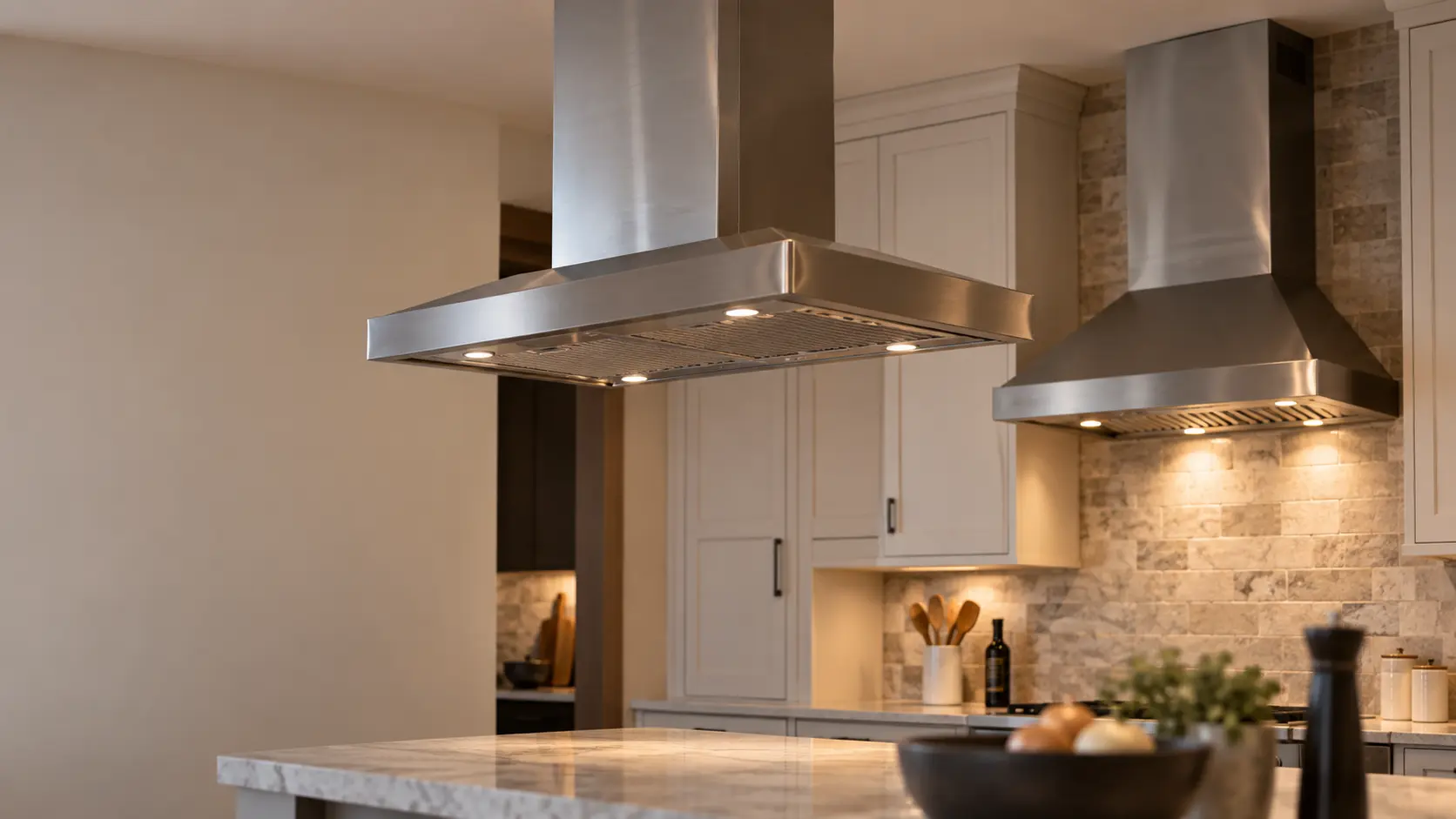
A wall-mount chimney hood hangs against the tile with its duct hidden in a tall cover, an under-cabinet hood tucks beneath the upper cabinets, an island hood drops from the ceiling over burners set into an island, and an insert is the working heart hidden inside a custom wood or plaster hood. Which one hangs over your burners?
All range hood types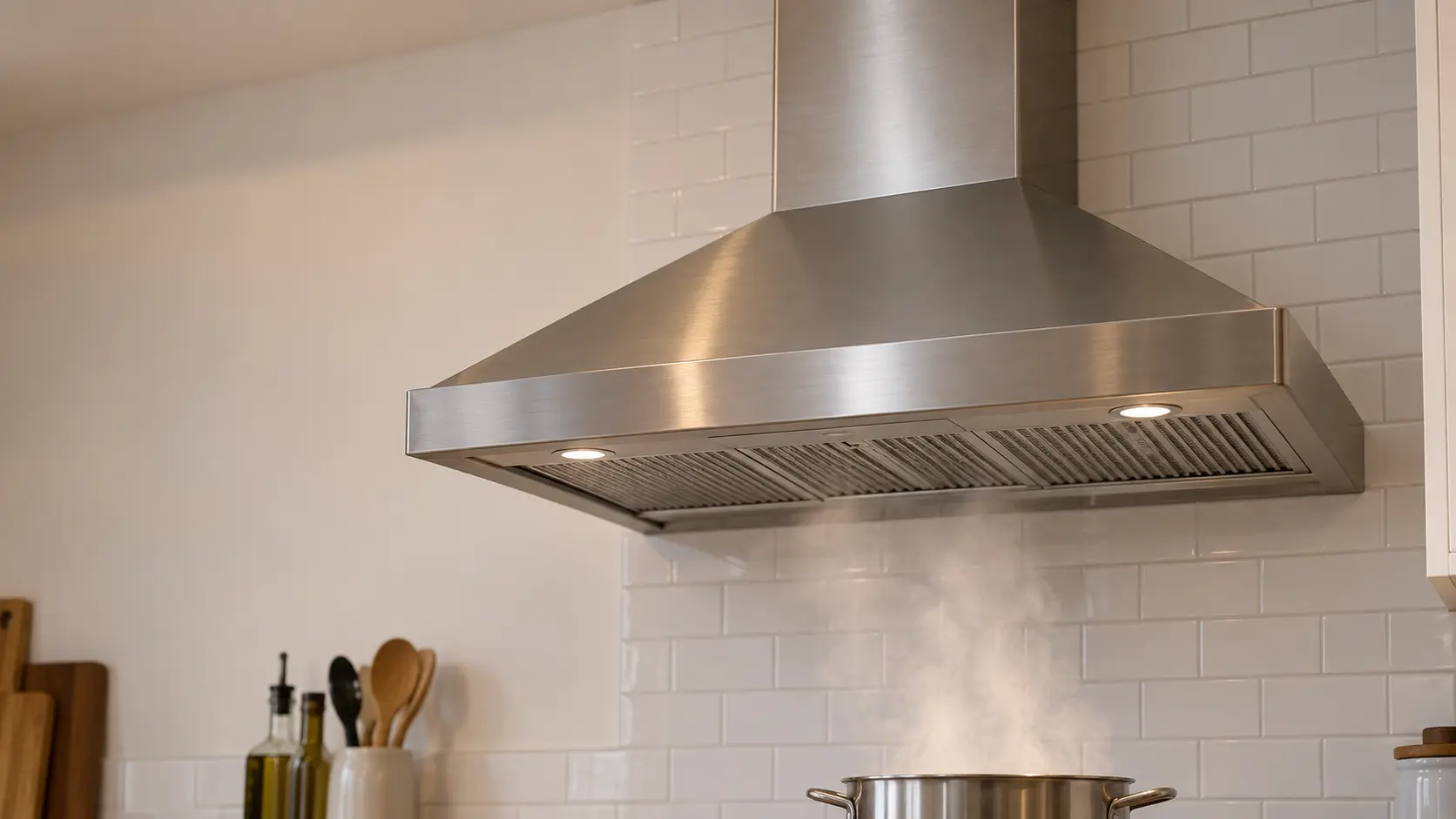
Wall-mount range hood
The chimney hood fixed to a bare stretch of wall above the burners, its canopy catching the rising smoke while a telescoping cover hides the duct that climbs to the ceiling.
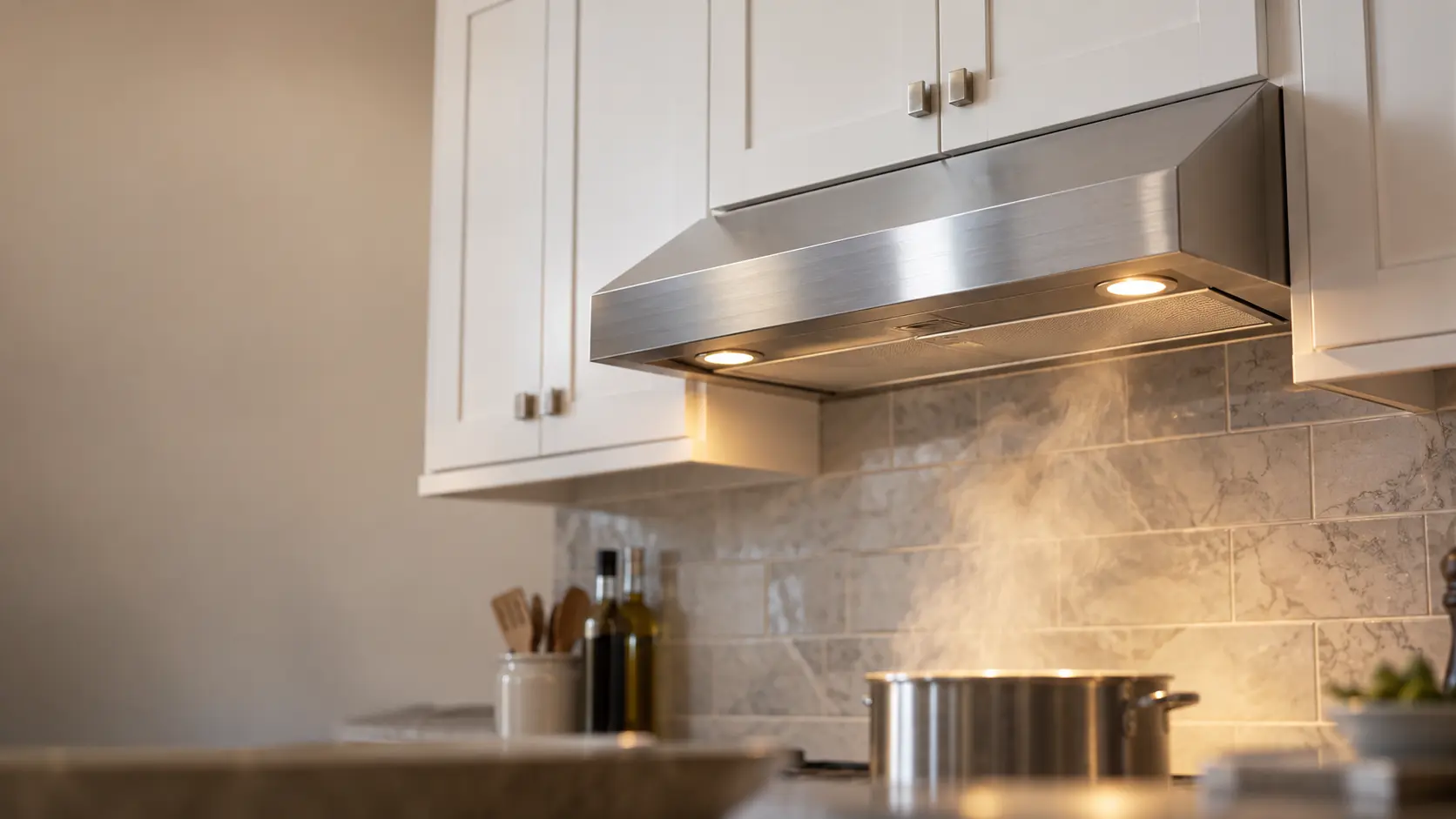
Under-cabinet range hood
The slim hood screwed to the bottom of the wall cabinet over the burners, venting up through that cabinet or back through the wall, or cleaning the air and returning it to the room.
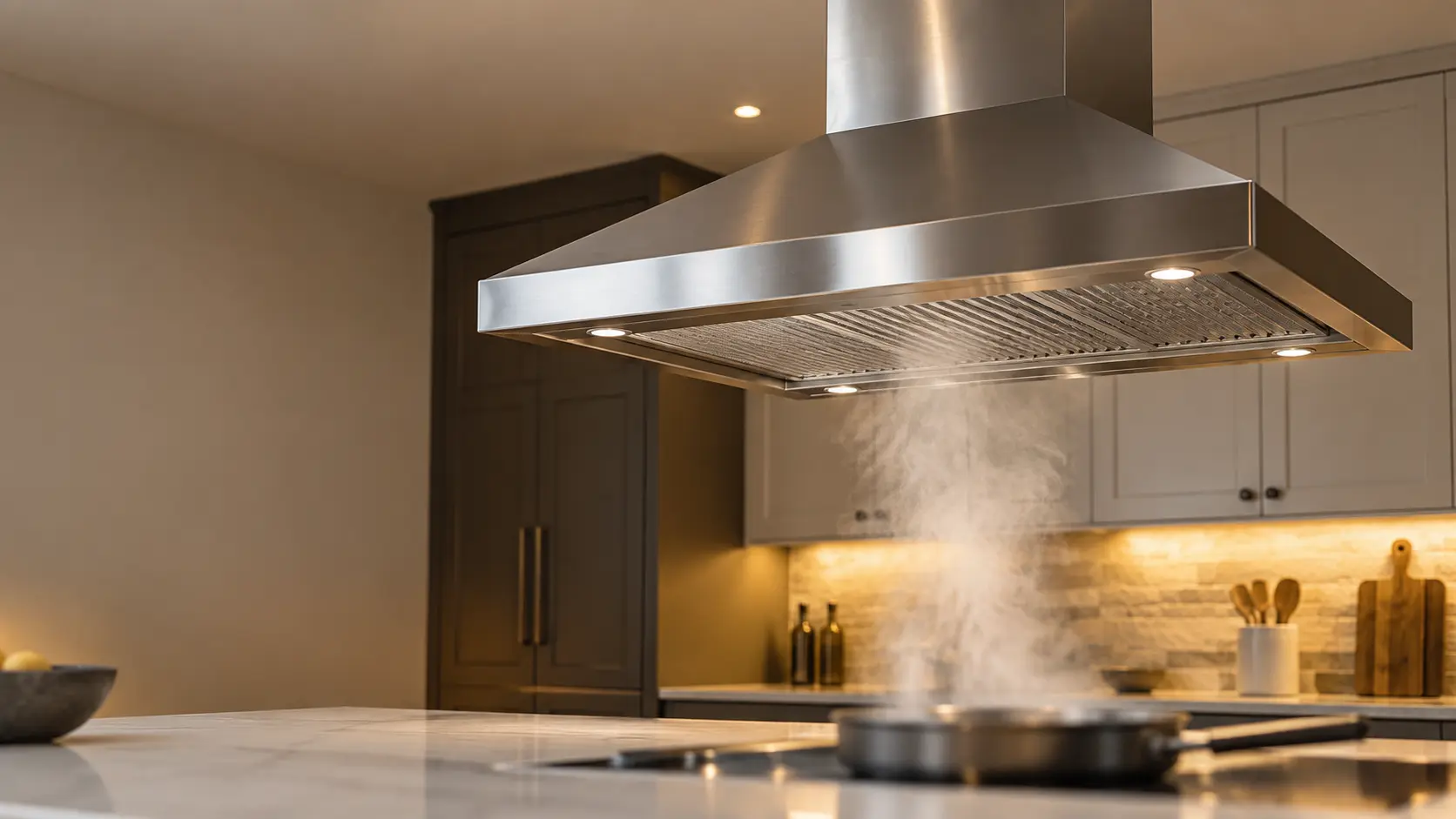
Island range hood
The hood that hangs from the ceiling over burners set into a kitchen island, open on all four sides, with its duct and wiring hidden inside a chimney that drops from above.

Range hood insert
The working core of a custom hood: a steel liner or power pack carrying the blower, filters, lights and controls, fitted inside a hood built of wood, plaster or metal by a cabinetmaker.
Every kind we serviceAll range hoods, side by side
The archive puts the 4 types against each other: how to tell which you own, what fails on each, and which manufacturers build them.
How to tell yoursWhat fails on eachWho makes them Open the type archiveSteam that rises and leaves.
A hood that stays quiet and put.
Maybe the smoke from searing rolls past the canopy into the room, the blower roars on high and whispers on low, the lights flicker out, grease beads on the filters and drips back onto the burners, or a cold draft slips in through the damper on a windy night. Start with the sign you noticed most recently; its page first explains where that sign usually leads, and only at the very end asks whether you want a visit.
 All 17 problems
Grease Fire Under or Inside a Range Hood
A range hood grease fire begins as a pan of oil that flares on the burner, then flame licks up toward the filters, or a glow and thick smoke appear behind the mesh where years of cooking fat have built up.
Hot Electrical or Burning Smell at the Range Hood
A range hood burning smell comes as hot plastic, singed dust or scorched oil near the canopy, often a few minutes after the blower or the lights come on, and sometimes it lingers after everything is switched off.
Sparks From a Range Hood Blower or Lights
A range hood sparking shows as bright flashes behind the filters or at a light socket, a snapping or crackling sound over the blower, sometimes a whiff of ozone and a light that blinks out at the same time.
Range Hood Keeps Tripping Its Breaker
A range hood tripping breaker cuts power the moment the blower starts, when the lights come on, or after a few minutes of running, and it can also take out a GFCI outlet that the hood shares with the counter.
Range Hood Pulling Away From the Wall or Ceiling
A range hood pulling away from wall or ceiling shows as a gap opening along the top edge, a canopy that tilts forward, a chimney cover that has slipped out of line, or a hood that shifts and creaks when the blower starts.
Range Hood Fan Not Working at Any Speed
A range hood fan not working stays silent on every setting, or hums for a second without spinning, while the lights may still turn on, and smoke from the pans drifts up into the kitchen instead of into the canopy.
Familiar brands. Expert care.
For the brands
in your kitchen.
Independent repair service. Not affiliated with, authorized or endorsed by any manufacturer. Brand names and model numbers are the property of their respective owners and are used here for identification only, to describe the appliances we service.
What a repair
usually costs.
Set the repair against what a new range hood would really take to put up, not just its price on a shelf. A chimney hood needs its brackets, duct collar and tile cut to line up again; an island model comes down from the ceiling frame with two people; an insert has to fit the opening a cabinetmaker built around it. Filters, lamps, switches, dampers, capacitors and heat sensors are small next to that, and even a blower or a board is usually the better choice on those three. A basic recirculating under-cabinet hood is the exception: it is quick to swap, so on an older one with a failed motor the technician shows you both numbers side by side.
| Repair | Relative cost | Notes |
|---|---|---|
| Blower motor, run capacitor, bearings or blower wheel | moderate to highest | A capacitor or a degreased wheel sits near the bottom of this band. A complete motor, a twin-blower assembly or a fan that lives in the attic or on the roof climbs to the top, with the reach adding labor of its own. |
| Rocker or slide switch, key panel, touch strip or wall keypad | low to moderate | A mechanical switch block on a basic hood is a small part. A glass touch strip, a membrane panel for a pro-style canopy or a remote keypad with its cable run through the cabinet moves one step up. |
| Control board with its relays and power supply | moderate | The board is the dearest electronic part in most hoods, and one for an imported or premium liner can take time to arrive. Clearing the grease or heat that cooked the old one is part of the same job. |
| Lamps, sockets, lens covers or the LED driver | low | Lamps and lenses are inexpensive. A scorched socket set, a low-voltage transformer or an LED driver hidden above the filters costs more, mostly in the time it takes to reach and test them. |
| Mesh or baffle filters, charcoal pads and the grease channel | lowest | Cleaning and refitting the filters with a new set of charcoal pads is the smallest job on this page. Replacement baffles for a wide pro-style canopy, or grease that has already reached the hood body, add to it. |
| Backdraft damper, duct joints or the outside cap flap | low to moderate | Freeing or replacing a damper at the top of the canopy is a small part and a short visit. Resealing joints above a ceiling, replacing a jammed wall or roof cap, or rerouting a choked run is quoted on its own once it has been seen. |
| Rattles, hum and vibration: wheel balance, mounts, gaskets and screws | low to moderate | Tightening loose panels, reseating filters and adding gaskets costs little beyond the visit. A new motor mount, a replacement wheel or bearings moves it up, and a mounting that has worked loose from the wall or ceiling is priced on sight. |
| Downdraft lift motor, drive gears, limit switches or its blower | moderate | A limit switch or a cleaned track is modest. A lift motor, a drive screw assembly or the blower under the counter costs more, and the cabinet below has to be emptied to reach them. |
| Heat sensor or thermostat disc and its lead | low | The sensor is a small part fitted from the underside of the canopy. When the board that reads it has also failed, the job joins the control board row instead. |
9 metros,
one appliance.
Where a range hood works decides what wears it out: a humid coastal kitchen where the damper rusts and the duct sweats, a family house that fries and sears every night, an apartment whose hood only recirculates because no duct reaches outside, a new airtight house where a strong blower fights for make-up air. Each note is about the range hoods in one town and the kitchens around them, and leaves the tourist sights to others.
All service areasTampa BayFL · 31 areas
Tampa Bay range hoods face humid air most of the year, salt near the bay and the Gulf, and storms that drive rain into wall caps and cut power for days, as the 2024 hurricanes did. Newer subdivisions often vent under-cabinet and chimney hoods through the attic, and a lanai may run an outdoor hood of its own.
OrlandoFL · 30 areas
Orlando range hoods serve family kitchens and vacation rentals where guests change every week and seldom clean the filters. Summer thunderstorms bring surges and outages, the 2022 and 2024 hurricanes left neighborhoods without power for days, birds nest in wall caps, and humid air settles grease on blowers.
Miami / South FloridaFL · 47 areas
South Florida range hoods live with salt air, humidity and hurricanes. Tower kitchens mostly recirculate through charcoal because the facade cannot be opened, houses vent through wall caps that corrode near the water, and storms push rain past a stuck damper and cut power to the hood for days.
New York MetroNY · 75 areas
New York range hoods are mostly under-cabinet units in small apartment kitchens, many recirculating because the facade or a co-op board rules out a new duct. Landmark districts shape where a brownstone can vent, long shafts in older buildings make blowers work hard, and gas cooking is still common in older apartments.
HoustonTX · 36 areas
Houston range hoods work in air that stays humid most of the year, which holds cooking grease and lays it on filters, blowers and ducts faster than elsewhere. Many houses vent through hot attics where remote blowers and ducts take the heat, and the long outages after Beryl and the 2021 winter storm ended with surges on kitchen circuits.
ChicagoIL · 50 areas
Chicagoland range hoods work through long, closed-window winters, when cold drafts back past worn dampers, wall caps ice over and tight newer houses struggle for make-up air behind a strong hood. Gas cooking is common, older bungalows and two-flats vent through masonry, and wind off the lake rattles loose flaps.
Los AngelesCA · 95 areas
Across Los Angeles, range hoods include under-cabinet units in older apartments, chimney hoods in Valley houses and custom inserts over pro-style burners in Westside remodels. The region sits in a seismic zone that can loosen a heavy hood on its mount, and the 2025 fires left ash in many filters and ducts.
San DiegoCA · 31 areas
San Diego range hoods near the coast take salt on their blowers, damper hinges and light sockets, while inland houses run theirs through hot summers. Utility shutoffs on windy fire days can end in a surge that reaches a hood's board, and ash from wildfires can load filters for weeks.
San Francisco Bay AreaCA · 74 areas
Bay Area range hoods run from small under-cabinet units venting into Victorian light wells to custom hood inserts with roof blowers in Peninsula remodels and downdraft vents in Eichler islands. Many newer houses cook on induction and older ones on gas, fog and coastal wind wear on wall caps, and in this seismic zone a heavy hood's mount deserves a check after a strong quake.

Answers before
you book.
How soon can a technician look at my range hood?
Do you work on the kind of range hood I have?
What should I get ready before the range hood visit?
What does fixing a range hood usually cost?
My range hood has hung there for many years. Is fixing it still sensible?
A pan caught fire under the hood. What now?
Work out what
you are dealing with.
Split by what you are trying to find out rather than by what part of the appliance it concerns.
All 22 guides
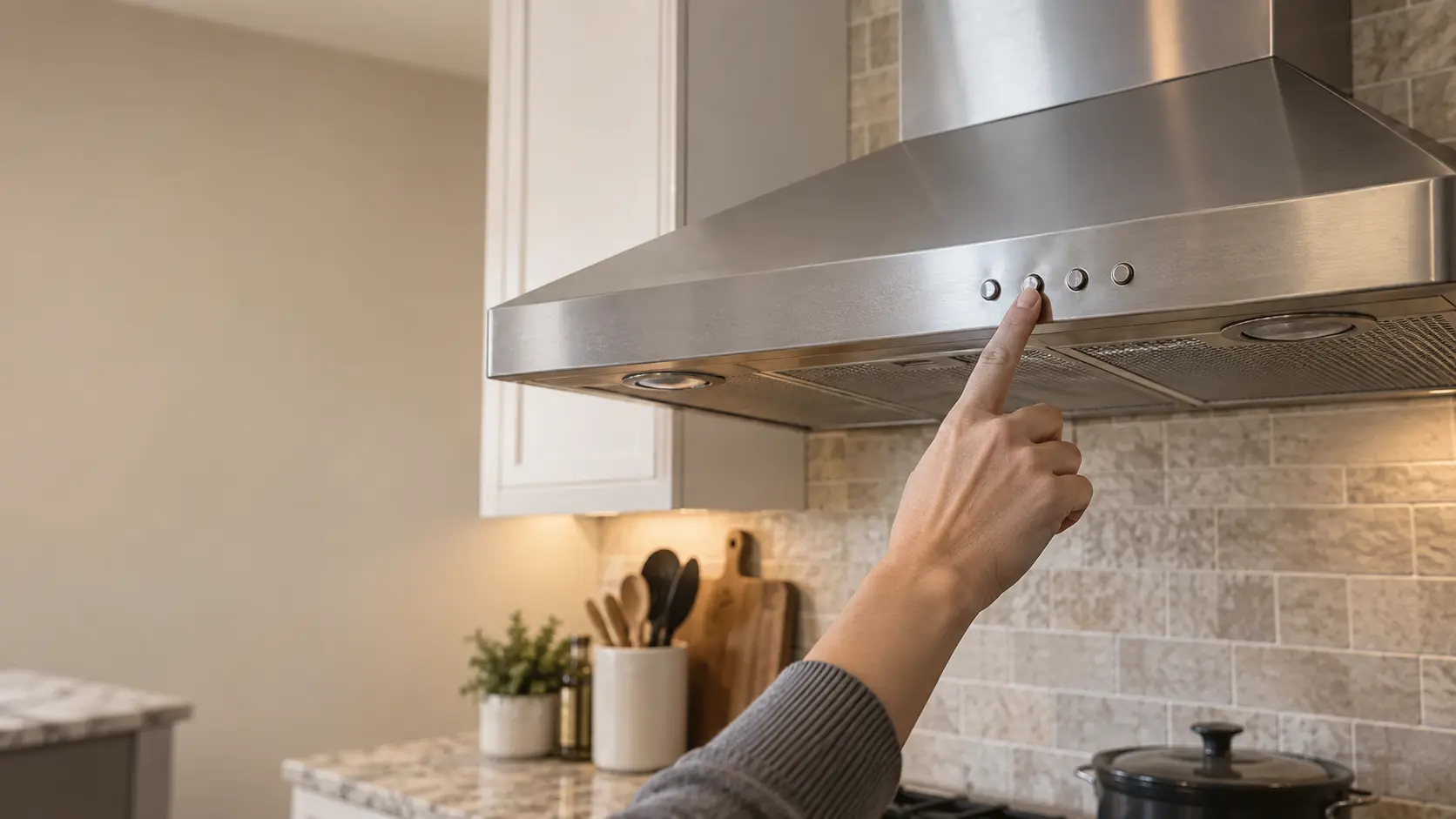



Curious what the repair might add up to? That has its own page, because no honest number exists before the hood has been tested — range hood repair cost.
Back to your everyday
Let’s get your range hood working again.
Three short steps, a window that suits you, and a price for the actual repair before any work starts.