

Island Range Hood Repair
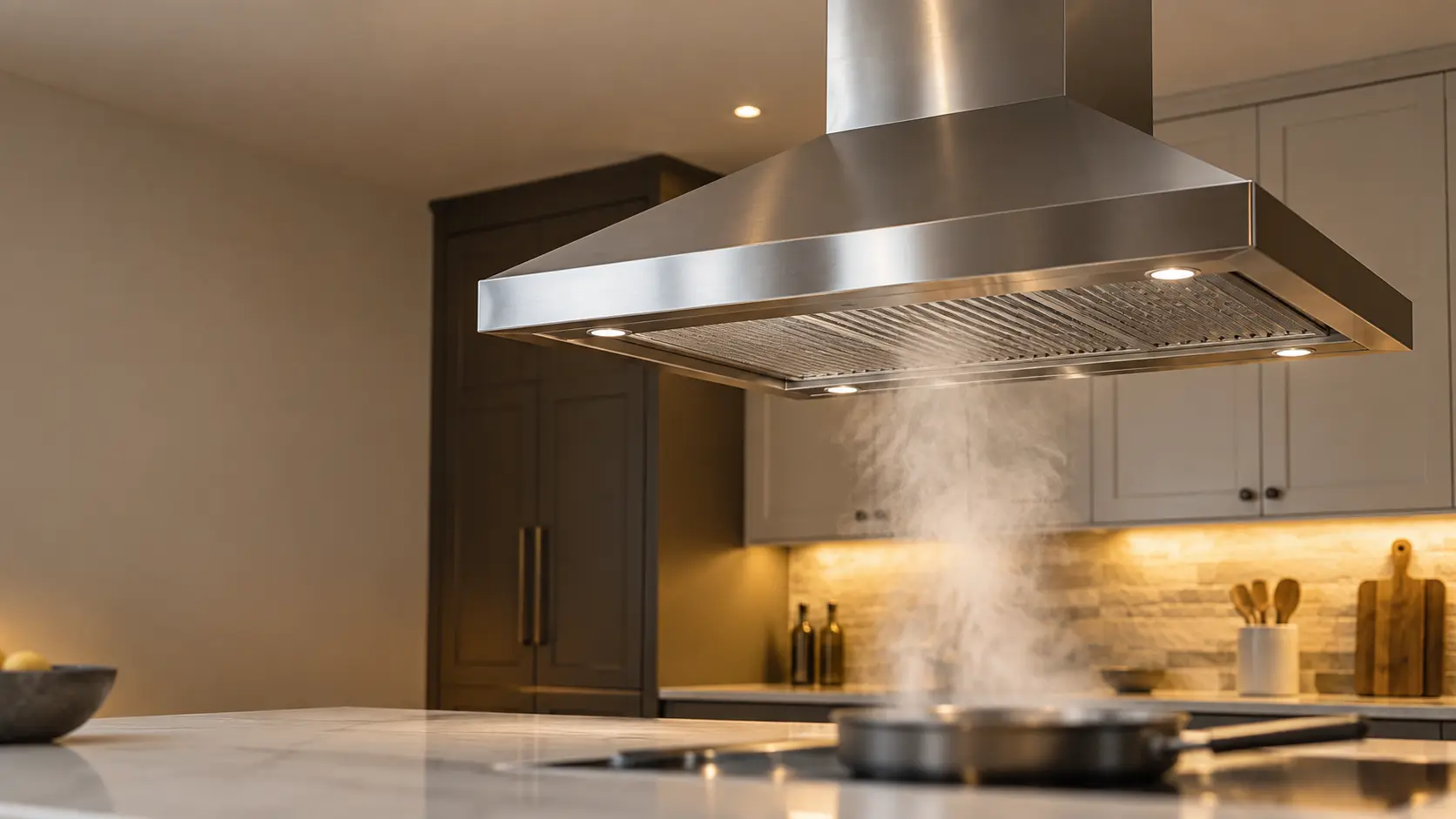
The hood that hangs from the ceiling over burners set into a kitchen island, open on all four sides, with its duct and wiring hidden inside a chimney that drops from above.
Mon–Sat, 8am–8pm
- 4 things that fail on it
- 24 makes build it
- 6 problems it shows
Book a visit
Three short steps, about a minute.
or call (844) 398-3217
Loading appointment form…
The appointment form couldn’t load. Please try again.
Is yours
an island?
An island range hood hangs from the ceiling over a cooking surface set into an island or a peninsula, with nothing behind it and nothing beside it. That open setting is why island hoods are wider and more powerful than wall models of the same cooking width: cross drafts from doors, windows and people walking past bend the plume before it rises, so the canopy has to reach further out to catch it. The weight is carried by a steel frame bolted to the ceiling joists, and a four-sided chimney cover drops from the ceiling to the canopy, hiding the duct and the power line. The blower may be inside the canopy or moved to an in-line housing above the ceiling or a roof unit. The duct usually runs sideways between joists before it can leave, so it is often longer and has more turns than a wall hood's, and grease and weak airflow show up here first. Because the hood is centered over the island and reached from every side, filters and lights are easy; anything inside the chimney cover waits for the technician and a proper ladder.
 What fails on an island range hood
How to tell
The hood hangs free over burners set into an island or peninsula, with open room on all four sides of the canopy.
Its chimney cover drops straight from the ceiling, finished on all four faces rather than just the front and sides.
The canopy is usually several inches wider than the burners it covers, and its filters face down on two or more sides.
You can walk around it: nothing touches it except the ceiling above and, through its cover, the duct and the power line.
Not yours?Wall-mount range hoodUnder-cabinet range hoodRange hood insert
What fails
on this design.
On an island range hood: grease in a long duct, rattles and sway from the ceiling frame, a blower that no longer keeps up, controls and a heat sensor over open burners.
The problems it showsGrease in a long duct
An island duct usually turns once or twice between ceiling joists before it reaches a roof or wall cap, and every turn is a place for grease to settle. The hood then pulls weakly, smells linger, and the buildup becomes a fire risk that no filter cleaning inside the kitchen can reach.
Rattles and sway from the ceiling frame
The canopy hangs on a frame bolted into the joists, and a hood that runs at high speed for years can work a bolt or a cover screw loose. The first sign is a rattle or a hum that changes when someone touches the cover; ignoring it lets the movement grow.
A blower that no longer keeps up
Island hoods carry larger blowers, often two motors or a remote fan, and a failing one leaves the hood running but pulling half of what it should. The difference hides well until someone sears a steak, and it is measured on the visit rather than guessed from the sound.
Controls and a heat sensor over open burners
With no wall to deflect it, heat rises straight into the canopy and its control board. A heat sensor that starts the fan on its own at the wrong time, or keys that stop answering after a long high-heat session, are common complaints on island models.
Getting at it,
and whether to.
The filters and lamps face down over the island and come out from the floor with the burners cold; that much you can do yourself.
What repairs costOn the visit
- The chimney cover, the ceiling frame and anything electrical behind them are reached from a ladder standing on the floor beside the island, and that work belongs to the technician.
- Where the blower is above the ceiling or on the roof, please tell us how the attic or roof is reached so the right equipment comes on the first visit.
- If the hood sways, knocks or has dropped even slightly, do not cook under it, keep everyone out from beneath it and do not try to push it back up; book it as urgent.
Repair or replace
Replacing an island hood means taking a heavy canopy down from the ceiling, matching a new frame to the old joists and often patching the ceiling finish around a different chimney, so repair is the sensible default. A motor, a board, a damper, a set of lamps or a keypad on an island model is nearly always worth fitting. A replacement becomes the better answer mainly when the hood is too small or too weak for the cooking beneath it, which the technician can tell you after measuring the airflow.
Book a visit for an island range hoodThe problems
it shows.
On an island range hood, most often range hood rattles or shakes while it runs.
All problems
Range Hood Rattles or Shakes While It Runs
6 causes, cheapest first

Range Hood Runs but Barely Pulls Smoke
7 causes, cheapest first

Range Hood Pulling Away From the Wall or Ceiling
6 causes, cheapest first

Range Hood Too Loud: Roar, Whine or Grinding
6 causes, cheapest first

Range Hood Fan Stuck on One Speed
6 causes, cheapest first
Range Hood Fan Won't Turn Off
6 causes, cheapest first
Who builds
an island.
24 of the makes on this site build an island range hood. Each mark opens that make's own page.
All 29 brandsIsland range hood repair,
where we come out.
9 metros, each with its own page.
All service areasTampa BayFL · 31 areas
Miami / South FloridaFL · 47 areas
New York MetroNY · 75 areas
HoustonTX · 36 areas
ChicagoIL · 50 areas
Los AngelesCA · 95 areas
San DiegoCA · 31 areas

Questions about
island range hoods.
Why does an island range hood need more airflow than one on a wall?
My island hood hums and shakes when it runs on high. Is that serious?
Is a downdraft vent handled on the same visit as an island hood?
Can I clean the duct above my island hood myself?
Back to your everyday
Is it an island range hood?
Say so when you book — it changes what the technician brings and how the visit is planned.