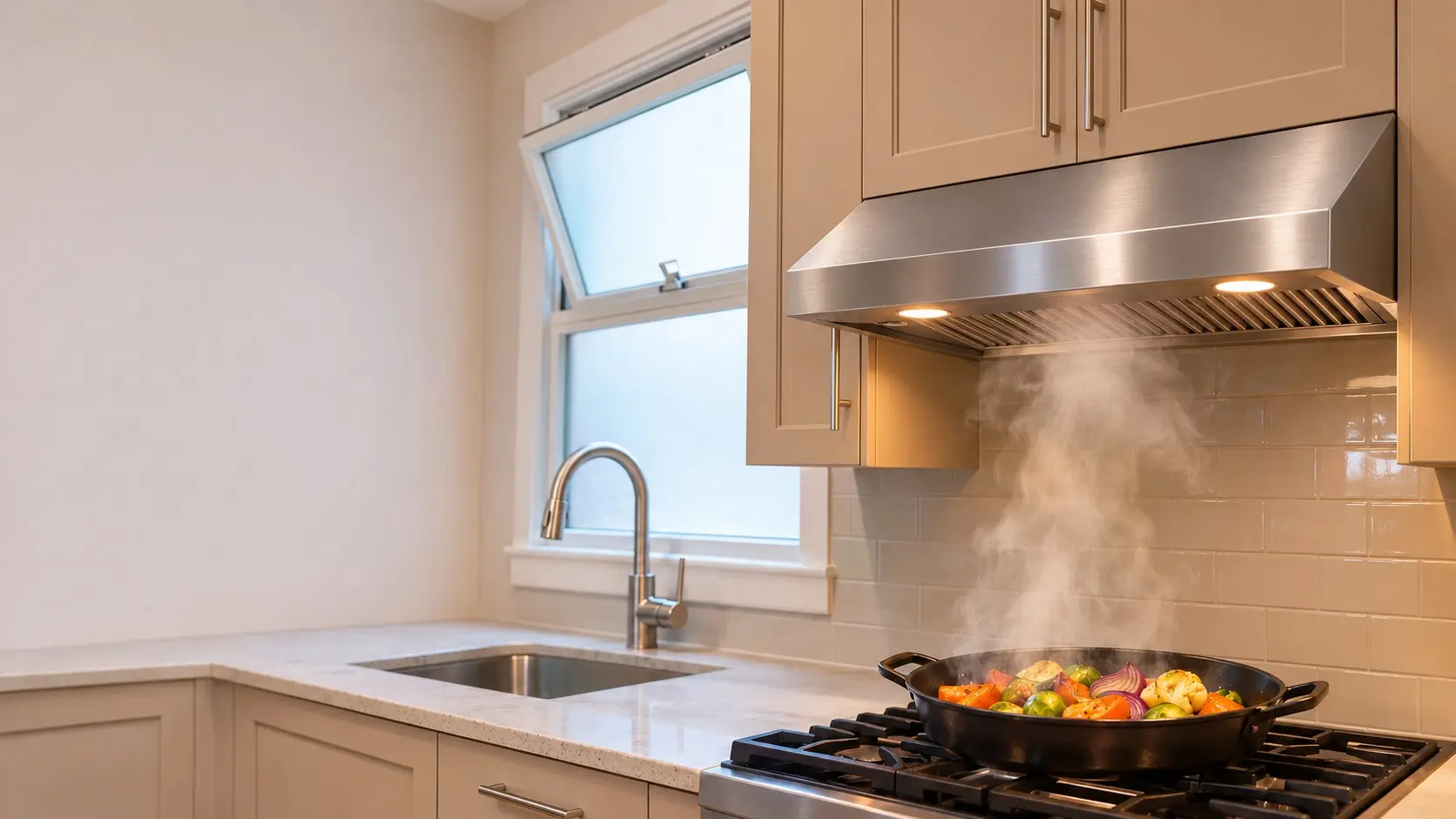


Why do cooking smells linger even with the hood running?
Smells linger because the hood is moving less air than the cooking is producing, or moving it somewhere that is not outside. Odor molecules travel in the rising plume, and whatever the hood misses spreads through the kitchen and soaks into fabric, cabinets and paint, which is why the house smells of the roast hours after the oven is off.
Think of the problem in two halves: capture and exhaust. Capture is whether the plume enters the hood at all. Exhaust is whether the air then leaves the house, or at least gets cleaned. A hood can fail at either half while the fan sounds perfectly healthy.
The quick test
Hold a single square of tissue near the front edge of the filter while a burner is on. A good hood pulls it firmly toward the filter. If it flutters weakly, the problem is airflow. If it pulls well but the smell stays, look at where the air goes next.
Is the fan speed and run time wrong?
Fan speed is the cheapest cause to fix, and the most common. Many owners run the hood on its lowest setting because the high speed is loud, which works for steaming rice and fails for searing or roasting.
- Start the hood before you turn on the heat, not after the smoke appears. A cold hood has to build airflow against air that is already circulating.
- Use a high speed for the first few minutes of searing, frying and broiling, then drop down once the surface is no longer smoking.
- Leave the hood running 10 to 15 minutes after you finish. Heat keeps lifting odors from pans, the oven door and dishes long after the burner is off.
- Use the back burners when the recipe allows it. The plume of a back burner sits deeper under the canopy.
Many hoods have a delay-off or timed run setting for exactly this purpose. Check the owner's manual for the control pattern, since it differs by model.

Can the hood's size and height cause it?
Yes. A hood narrower than the cooktop or mounted too high lets the plume roll out past the edges. The plume is wider at the pan than it looks, and warm air spills sideways when the hood cannot catch it.
| Setup | What happens to the plume | What helps |
|---|---|---|
| Hood narrower than the cooktop | Edges of the pans lose smoke to the room | Use inner burners, raise the fan speed |
| Hood mounted high above the cooktop | The plume cools and spreads before reaching the filters | Lower the hood within the manual's limits, if the install allows |
| Island hood in an open room | Crosscurrents from doors and vents push the plume away | Close nearby vents, add a few seconds of high speed |
| Wall hood with deep canopy | Strong capture along the wall, weaker at the front | Cook on the rear burners |
Mounting height is set by the manufacturer's instructions for your model and by the type of cooktop below it, so check the manual before moving anything. If the hood is a different type than the one you described, see the under-cabinet hood guide for how that style is built, or read the sizing basics in sizing a hood and its airflow.
Is a ducted or a recirculating hood doing the work?
A ducted hood sends the air outdoors. A recirculating hood pushes it through a charcoal filter and back into the room, so it can only be as good as that filter. You can tell which you have by looking at the top of the hood for a round or rectangular duct collar, or by checking whether the discharge sits behind the front grille.
Charcoal filters
A charcoal filter that is past its life does not stop odors, it just warms them and returns them. The owner's manual gives the replacement interval for your model, and heavy frying uses a filter up sooner than that. Charcoal cannot be washed back to life, and a filter that has never been changed since you moved in is almost certainly spent. Our guide on when to change charcoal filters covers how to tell.
Grease-loaded mesh and baffle filters
Metal filters trap grease, and when they are coated the air passes through a narrower gap and the fan has to work harder. That lowers airflow at every speed. Wash them as described in cleaning mesh and baffle filters, and if grease has built up inside the canopy, a filter and baffle service cleans the parts you cannot reach.
What if the damper or duct is the problem?
A backdraft damper is a flap in the duct that opens when the fan runs and closes when it stops. If it is stuck shut, or only cracks open, the fan runs and sounds normal but the air has nowhere to go. A damper that hangs open lets cold air and outdoor smells back in.
Signs to look for:
- A faint clicking or flapping from the ceiling or wall when the fan starts.
- Weak airflow at the filter even with clean filters.
- A cold draft or an outdoor smell when the fan is off.
- The wall or roof cap outside does not lift when the fan runs on high.
Duct runs with many elbows, crushed flex duct or a cap clogged with lint and grease cut airflow sharply. The details are in duct runs and the backdraft damper. When a damper or duct needs freeing or replacing, that is a damper and duct repair. A tightly sealed modern house can also starve a strong hood of replacement air, see make-up air for a strong hood.
What can you change tonight, and what needs a visit?
Work through this list in order. It takes under an hour and costs nothing.
- Take out the metal filters and look at them. Dark, sticky or dripping means wash them now.
- Switch the fan to high and do the tissue test.
- If your hood recirculates, find the charcoal filter and check its age.
- Open a window a few inches on the opposite side of the kitchen. If the smell clears faster, the house is short of replacement air.
- Ask someone to run the fan on high while you watch the wall cap from outside, or a roof cap from the ground. Do not climb onto the roof to check it.
If all five come back normal and the smell still lingers, the blower itself may have lost power or the duct may be partly blocked in a place you cannot see. That is a job for a diagnostic visit, where airflow is measured rather than guessed.


