

Where does the air leave, and which knockout do you open?
The air leaves through whichever opening matches your duct route, and the hood has a stamped knockout for each one. Choose the route first, because the cabinet cut depends on it.
Top or back discharge
An under-cabinet hood typically offers a round or rectangular opening on the top, and often a second one on the back. Top discharge goes up through the cabinet above and then to the attic or an outside wall; back discharge goes straight into the wall behind. Pick the shorter route with the fewest elbows, since every bend takes airflow away.
Opening the knockout
Use the knockout your route needs and leave the others closed. Score around the stamped tab with tin snips or flex it back and forth until it detaches, and wear gloves because the edge is sharp. If the hood will recirculate instead, no knockout is opened, and the guide on a convertible range hood lists what that setup needs.
How do you mark and cut the cabinet?
You mark from the paper template in the carton, not from measurements taken by eye.
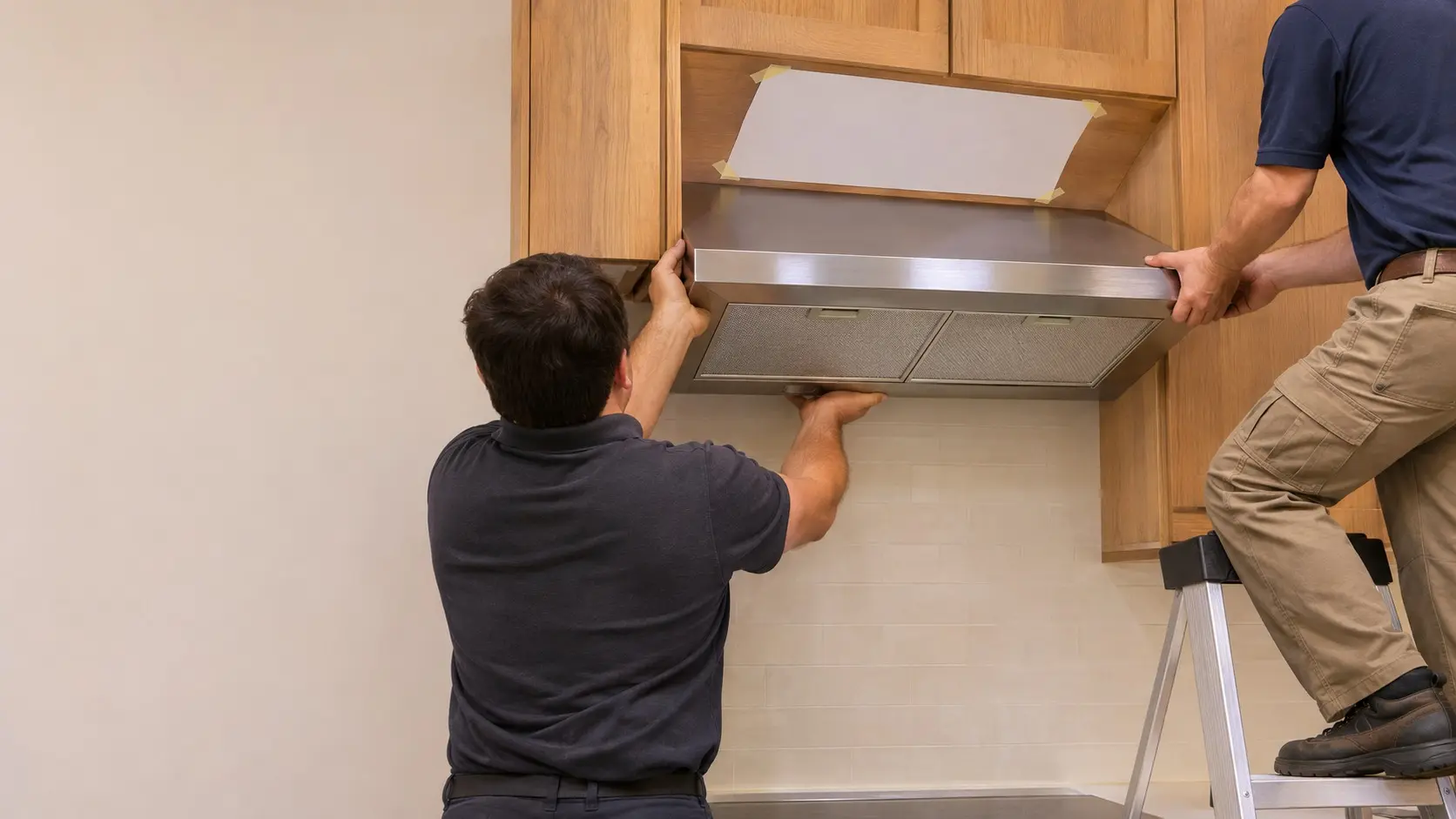
- Tape the template to the underside of the cabinet, lined up with the front edge and centered over the stove.
- Mark the duct opening, the screw positions and the cable entry.
- Drill a small pilot hole at each corner of the duct opening before you cut anything.
- Check from above that nothing in the cabinet, such as a shelf support or a pipe chase, sits in the cut.
Cutting the opening
Drill the corners, then cut between them with a jigsaw or a hole saw sized to the duct. Cut on the waste side of the line and clean the edge, since the transition needs a flat seat. Wear eye protection and keep a vacuum at hand; wood dust falls on the stove.
Hanging height
The manual gives the allowed distance between the stove surface and the underside of the hood. The two numbers that matter are the minimum above the burners, to keep heat off the hood, and the maximum, to keep it catching smoke. Read both before you commit to the screws.

Which way does the damper face?
The damper's flap opens in the direction the air travels, away from the hood, and falls closed when the fan stops.
Check the arrow or the hinge: the flap should lift away from the hood when air pushes it and drop closed when the fan stops. Before you fit it, test three things:
- the flap moves freely by hand and nothing in the collar blocks it
- the arrow or hinge side points toward the outside
- it seats flat in the collar with no gap that lets air leak around it
If it goes in backwards, the flap sits pinned open or shut, the fan sounds strangled and cold air comes back down the duct. Our guide to duct runs and the backdraft damper shows what a healthy one does.
Duct joints
Use metal duct of the diameter the manual specifies, joined with the crimped end of each piece pointing the way the air travels. Seal seams with foil tape, not cloth duct tape, and end in a wall or roof cap with its own damper. If a damper later sticks or the run needs changing, the damper and duct repair service handles it.
How is the hood hung and wired?
The hood hangs on screws into the cabinet bottom or on keyhole slots that take screws first, and the wiring box is connected last, by an electrician, with the breaker off.
Support screws
Drive the screws through the mounting holes in the hood's flange into solid cabinet wood, using the length the manual states so that the point does not come through the cabinet's top surface or the face of a shelf above. Hang the hood on the screws partway driven, check that it is level front to back and side to side, and tighten. A hood hung only on thin cabinet material can sag, and the symptom described in a hood pulling away from the wall starts there.
The wiring box
The house cable enters the hood's wire cover through a clamp and is joined to the hood's leads and ground as the wiring diagram shows. That connection is for an electrician: the circuit has to be switched off and proven dead, the cable has to be in good condition and grounded, and local rules may require a permit. Have the cable end left where the template's cable entry sits, so the hood can be hung over it. A hood that stays dark after hookup is covered in the fan not working page.
Setting the airflow limit
Some hoods carry a selector, jumper or setting that caps the top airflow for houses that need make-up air above a certain level. If your hood has one, set it at installation. Make-up air for a strong hood explains when that matters, and sizing a hood and its airflow covers the choice of size.


