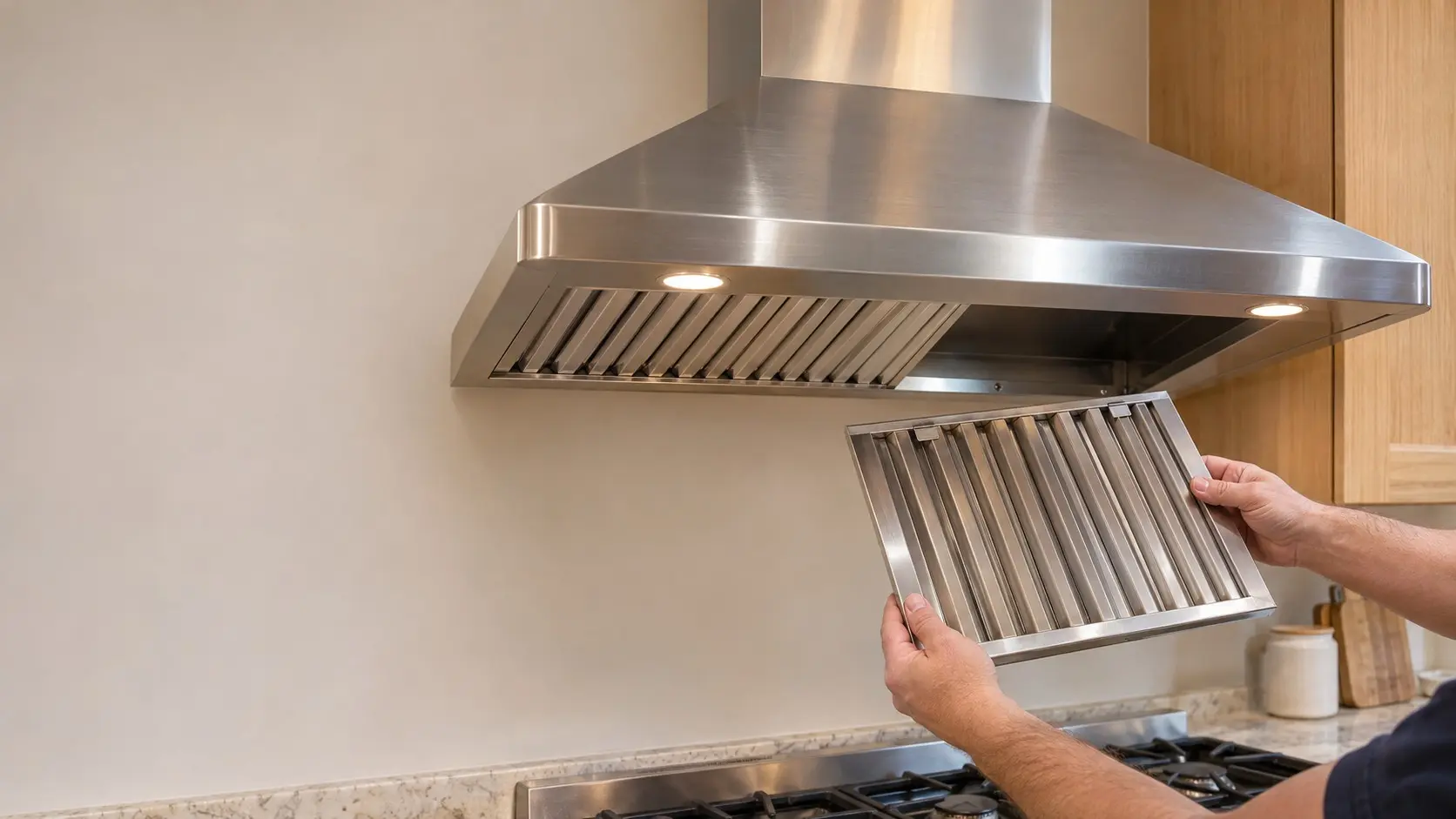


When is a range hood filter past washing?
A grease filter is ready to replace when washing no longer brings it back, or when its shape stops it doing its job. Metal filters last years, so the question is condition, not age.
- A filter that stays gummy or dark after a hot-water soak and a second wash.
- Bent, bowed or dented frames that leave a gap along the edge.
- Pitting, flaking or green or white corrosion on aluminum mesh.
- A torn mesh layer, or baffles whose channels are crushed.
- A latch or handle that no longer holds the filter up.
Try the cleaning steps in cleaning mesh and baffle filters; use them first, and replace only when it fails. A hood that still pulls weakly after a clean filter may have a different issue, see weak suction.
A quick test at the sink
Hold the cleaned filter to a light. On mesh, you should see light through most of the screen, not a film. On baffles, run a finger down a channel; it should feel bare metal, not tacky. A filter that fails either test, and a hood that still pulls weakly, are the case for a new one.
What kind of filter does my hood take?
Hoods use one of three setups, and a replacement has to match: you cannot swap one kind for another.
| Filter type | Looks like | Upkeep | Replace when |
|---|---|---|---|
| Aluminum mesh | Thin layered screen in a light frame | Wash by hand or in the dishwasher if the manual allows | Corroded, torn or permanently greasy |
| Stainless baffle | Rigid channels, usually with a handle | Wash; very durable | Dented, warped or rusted |
| Charcoal (carbon) | Pad or cartridge behind or over the grease filter | Never washed | On the maker's schedule or when odors return |
Some hoods carry no mesh or baffle filter at all; if yours does not have one, there is nothing to order, and the blower shields are cleaned instead, as the owner's manual says.
Where charcoal belongs
If your hood is recirculating, with no duct outside, the grease filter is not the only one: a charcoal filter sits in the path too. It is a consumable that is replaced and not washed; the whole story is in when to change charcoal filters.

How do I measure for the right replacement?
Order from the model number whenever you can, and measure only when the label is gone. The label is covered in finding the range hood model label; on many hoods it sits on the inside wall of the canopy or behind the filter.
Measuring a filter that has to be matched by hand
- Lay the old filter flat on a table and measure the long side and the short side to the nearest sixteenth of an inch, frame edge to frame edge.
- Measure the thickness, usually under an inch for mesh and a little more for baffles.
- Note the shape of the corners (square or cut) and where the handle or latch sits.
- Count how many filters the hood uses; most use two or more of the same size.
If grease has already reached the canopy edge, read about dripping grease. A filter a quarter inch too short will rattle and let grease past the gap; one slightly too large will not seat. If you are between sizes, check the part number from the maker rather than rounding.
Buy the filter type your maker lists. Third-party parts can fit but may differ in the density of the mesh or the baffle design, so for a hood in good condition the maker's part is the safer buy, and a filter and baffle service visit can fit it for you.
How do I fit a new filter safely?
Switch the hood and its light off, let the lamps cool, and fit the new filter the way the old one came out; there is no wiring involved.
- Mesh and baffle filters generally push up into a channel, then drop down and swing in, or release with a spring latch or a handle pull.
- Slide the new filter in the same direction, check that the latch clicks, and tug lightly to confirm it holds.
- Switch the hood on for a minute and listen. A rattle means a poor seat or a loose latch; a whistle at the edge means a gap.
- Never run the hood without its grease filters. They protect the blower, the duct and the fan wheel from a layer of grease that is hard to remove.
On a wall-mount hood the filters lift out from below. If the fan was loud before, a loose filter may have been the cause, as discussed in why a range hood gets loud.
How long should a replacement last?
There is no fixed lifespan. A mesh filter on a hood used lightly may last many years; a heavy frying household will wear one out sooner. What matters is the care you give it and the cooking you do.
- Clean grease filters on the schedule your manual gives. Makers' published intervals vary from model to model and by filter type, and all of them say to clean sooner when you cook with a lot of grease or notice odors or weaker airflow.
- Wipe the frame and the canopy underside during each wash so grease does not drip back.
- Replace a washed filter that has gone dull and gray; the manual for many models notes that dishwasher washing can discolor metal filters, which is a looks matter and not a reason to replace it.
The yearly check in a yearly range hood check gives you a moment to look at the filters, the damper and the light, and to decide what to order before the busy season.


