


Range Hood Insert Repair
The working core of a custom hood: a steel liner or power pack carrying the blower, filters, lights and controls, fitted inside a hood built of wood, plaster or metal by a cabinetmaker.
Mon–Sat, 8am–8pm
- 4 things that fail on it
- 27 makes build it
- 6 problems it shows
Book a visit
Three short steps, about a minute.
or call (844) 398-3217
Loading appointment form…
The appointment form couldn’t load. Please try again.
Is yours
a insert or liner?
A range hood insert is what makes a custom hood work. The outer shape, a carved wood mantel, a plastered cone, a copper or painted steel shell, is built by a cabinetmaker or a plasterer, and inside it sits a steel box made by an appliance maker: the insert, also sold as a liner or a power pack. It holds the grease filters, often commercial-style baffles, the lights along its front edge, the controls on a small strip or a separate wall keypad, and the blower, either built in or replaced by a connection to an in-line or roof fan. Because the insert is recessed into someone else's work, access is the whole story on these visits. The filters and lights come out from below; the motor and the board are usually reached by dropping a panel inside the liner, and the wiring and the damper may sit behind the custom shell where only the technician should reach. Grease and heat are the main enemies: a wooden hood with a liner that no longer seals well can get warm, and the liner's seams must be kept clean.
 What fails on a range hood insert
How to tell
The hood looks like furniture or masonry, a wooden mantel, a plaster curve or a hammered metal shell, rather than a stainless appliance.
Looking up from below shows a flat stainless panel set into the custom shell, with filters, lamps and sometimes a small control strip.
The controls may be on a separate keypad on the wall or the cabinet side instead of on the hood itself.
A maker's rating plate is usually inside the liner, visible once a filter is out, not on the outside of the custom hood.
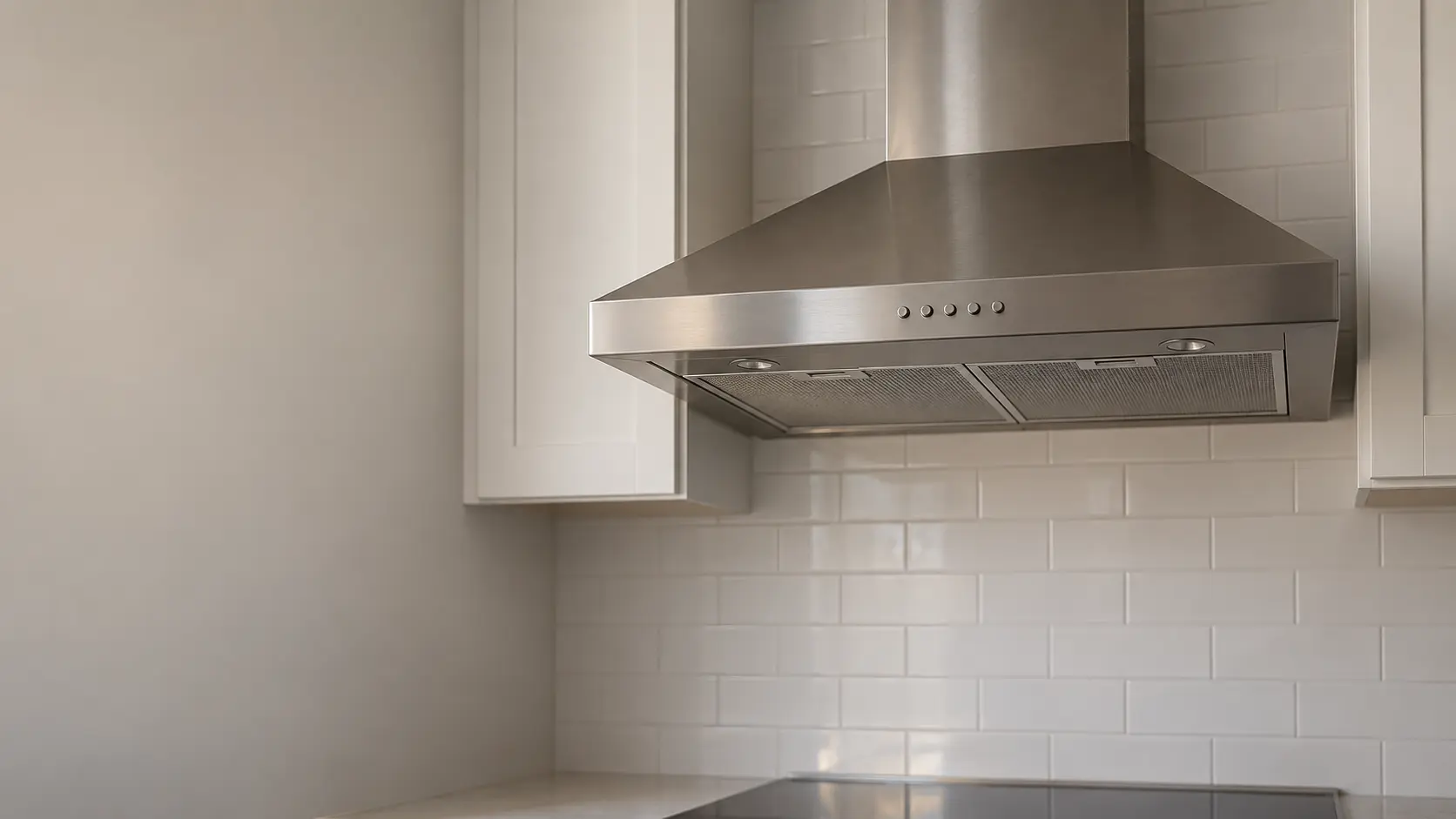
Not yours?Wall-mount range hoodUnder-cabinet range hoodIsland range hood
What fails
on this design.
On a range hood insert: baffles and liner seams full of grease, a power pack motor behind a panel, remote keypads and their cable, lights in a recessed front rail.
The problems it showsBaffles and liner seams full of grease
Commercial-style baffles catch a great deal of grease, and the seams of the liner behind them catch the rest. Over time the buildup narrows the airflow and holds heat against the wood or plaster around the liner, which is a fire hazard as well as a performance problem.
A power pack motor behind a panel
The blower in an insert hides behind an inner panel and is cooled only by the air it moves. Once its bearings wear or its capacitor weakens, it hums, starts slowly or runs hot and trips its protector, and reaching it can mean working carefully around the custom shell.
Remote keypads and their cable
When the controls are mounted away from the hood, a thin data cable runs through the cabinet or the wall to the board in the liner. A pinched or disconnected cable, or a board damaged by heat, leaves the hood deaf to every key while the lights on the pad still glow.
Lights in a recessed front rail
The lamps sit in the front rail of the liner, close to the heat and the steam, and on many inserts they run from a small transformer or LED driver tucked above the filters. Dead lights with good bulbs point to that driver or its connector.
Getting at it,
and whether to.
The filters and lamps come out from below, and most visits begin there; please take nothing else apart inside the liner.
What repairs costOn the visit
- Tell us who built the custom hood and whether it has a removable panel, because some shells hide the damper and the wiring behind trim that must come off without marking the finish.
- Do not climb up into the shell or reach for the power connection behind the liner; the breaker and the switch are all the owner side needs.
- If the blower is in the attic or on the roof, let us know how that space is reached before the appointment.
Repair or replace
An insert is almost always repaired rather than replaced, because a new liner has to match the exact cutout the cabinetmaker built, and a different size means rebuilding part of the custom hood. Filters, lights, a keypad, a capacitor or a motor are fitted from inside the liner. When the maker no longer supplies a board or the right motor, the technician may offer an insert of the same dimensions from another maker, and you see what it would mean for the custom shell before deciding.
Book a visit for a range hood insertThe problems
it shows.
On a range hood insert, most often range hood fan not working at any speed.
All problems
Range Hood Fan Not Working at Any Speed
6 causes, cheapest first

Range Hood Too Loud: Roar, Whine or Grinding
6 causes, cheapest first

Grease or Oily Water Dripping From the Range Hood
6 causes, cheapest first

Range Hood Buttons or Keypad Not Responding
6 causes, cheapest first
Range Hood Keeps Tripping Its Breaker
6 causes, cheapest first

Range Hood Runs but Barely Pulls Smoke
7 causes, cheapest first
Who builds
a insert or liner.
27 of the makes on this site build a range hood insert. Each mark opens that make's own page.
All 29 brandsRange hood insert repair,
where we come out.
9 metros, each with its own page.
All service areasTampa BayFL · 31 areas
Miami / South FloridaFL · 47 areas
New York MetroNY · 75 areas
HoustonTX · 36 areas
ChicagoIL · 50 areas
Los AngelesCA · 95 areas
San DiegoCA · 31 areas

Questions about
range hood inserts.
What is the difference between a hood insert, a liner and a power pack?
Can a wooden custom hood catch fire from a grease-loaded insert?
My custom hood's wall keypad lights up but the fan will not start. What does that suggest?
Will the custom shell be damaged if the insert needs work?
Back to your everyday
Is it a range hood insert?
Say so when you book — it changes what the technician brings and how the visit is planned.