
Power: the breaker, the wall switch and a reset
A hood that is completely dark, with no lights and no response from any key, should be checked from the power side first. Most hoods are hard-wired into a junction box hidden inside the chimney cover or the cabinet above, so the only way an owner can cut or restore power is at the panel, and sometimes at a wall switch that an electrician added.
The breaker
Find the breaker that feeds the hood; it may share a circuit with the lights or the outlets along the backsplash. A tripped handle sits between on and off. Push it firmly to off, then back to on, once. If it trips again when the hood starts, or the moment you touch a key, stop there and leave it off.
A wall switch nobody remembers
Some installations put a switch beside the doorway or under the upper cabinets to cut power to the hood, or to a remote blower on the roof. A switch left off by a cleaner or a painter produces a hood that looks dead. Try every unlabeled switch in the kitchen before assuming the worst.
A one-minute reset
An electronic control that has hung after a power flicker often recovers if it is left without power for a minute. Switch the breaker off, count sixty seconds, and switch it back on. Then try one speed and one light, rather than pressing everything at once.
Source: Zephyr — Firenze ZFI-M90S use, care and installation guide — A unit that does not work: make sure the circuit breaker and the unit's power are on; delay off runs 15 minutes; the display flashes F and C as filter reminders
What the keypad is already telling you
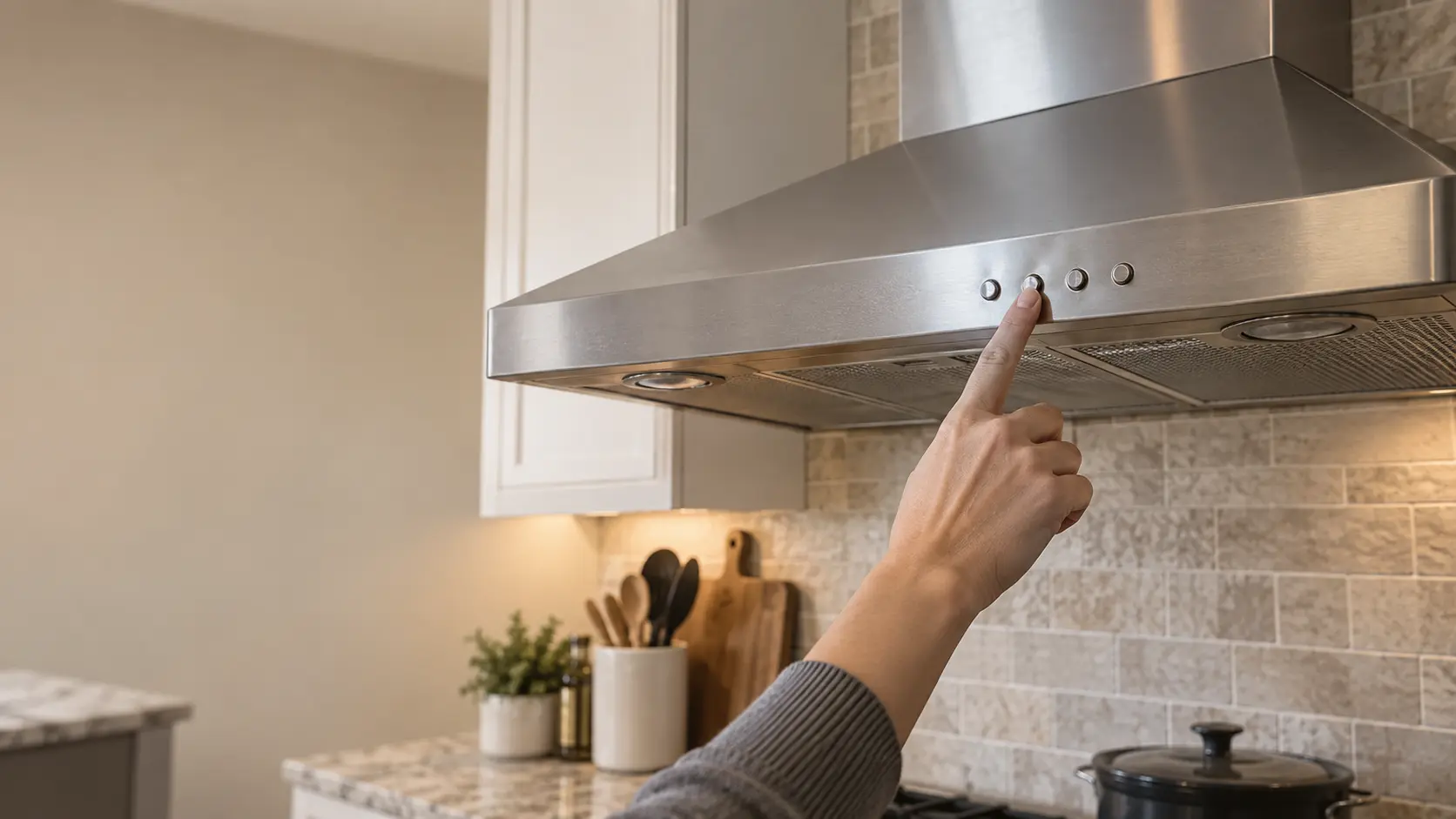
Before calling a control broken, read it. A blinking filter key or a letter on the display is usually a maintenance reminder; a blinking speed key may be a delay-off timer that will end the run by itself in ten or fifteen minutes; and on Broan's BQLA1 series all the blower keys blinking together mean the heat protection has taken over and will hand control back once the canopy cools.
Our guide to the indicator lights goes through these one by one. For this check, simply photograph the panel exactly as it looks, including anything that blinks, and note whether it responds to one firm press of the power key.
- Filter symbol or letter blinking: a reminder, not a breakdown.
- One speed key blinking after you pressed off: likely a delay-off timer.
- All blower keys blinking at once: heat protection; wait until it cools.
Source: Broan-NuTone — BQLA1 and NQLA1 range hood installation, use and care manual — A blinking speed key shows an active 10-minute delay-off; all blower sensors blinking means Heat Sentry has taken over; the filter reminder blinks after the blower is turned off; Zephyr — Firenze ZFI-M90S use, care and installation guide — A unit that does not work: make sure the circuit breaker and the unit's power are on; delay off runs 15 minutes; the display flashes F and C as filter reminders

Filters, from below
Take the grease filters down; they are made to come out by hand, with a latch or a finger pull. Look at them against the light, and look up through the opening with a flashlight at what you can see of the blower inlet. Heavy grease on the filters explains weak draw and some noises, and a drip of grease from the edges means they are past due.
While the filters are out, look for anything that should not be there: a dishcloth pulled up into the opening, a piece of foil, a loose light lens. Then put the filters back before running the fan again, so that grease has somewhere to go.
A paper-towel draw test on each speed
With the filters back in and no burner lit, hold a single sheet of paper towel flat under the middle of the hood, a few inches below the filters, and run each speed in turn. On a healthy hood the sheet is pulled up against the filters on the higher speeds and at least lifted clearly on the lowest one.
The result is not a measurement, but it is honest and repeatable. Take a short video of the sheet on each speed so that you, and the technician, can compare it later. A sheet that barely moves on high with clean filters sends you toward the damper, the duct or the blower; our guide to a hood that stopped pulling smoke covers that path.
- Sheet held against the filters on high: airflow is fine.
- Sheet lifts but falls away on high: check the filters again, then the room.
- Sheet barely stirs on any speed: a damper, duct or blower visit.
Listen, smell and time it
Run the fan on high for five minutes with the burners off. Listen for a hum without spin, a scrape, a rattle or a squeal, and smell for anything hot or electrical. Broan explains in its manuals that its motors carry a thermal overload that stops the motor when it overheats and restarts it once cool, and that a motor which keeps cycling like that should be serviced.
If the fan runs for a few minutes, stops, and then starts again on its own with nothing touched, write down how long each run lasted. That pattern is useful to a technician and is not something to keep testing.
Source: Broan-NuTone — BCSD1 range hood installation, use and care manual — The thermal overload shuts off an overheated motor and restarts it when cool; a motor that keeps shutting off and restarting should be serviced
The notes that make the visit shorter
Photograph the model label, which is usually behind the filters or on an inside wall of the canopy, and write down the kind of hood: under-cabinet, wall chimney, island, an insert hidden inside a custom hood, or a downdraft that rises behind the burners. Note whether it vents outside or recirculates, where the blower is if you know, what the display showed and what the paper test did on each speed.
Add the history in one or two lines: when it started, whether it followed a storm, a remodel, a new roof or a boil-over, and whether the breaker has tripped. That is enough for the technician to arrive with a likely part rather than a guess.