

Wall-Mount Range Hood Repair
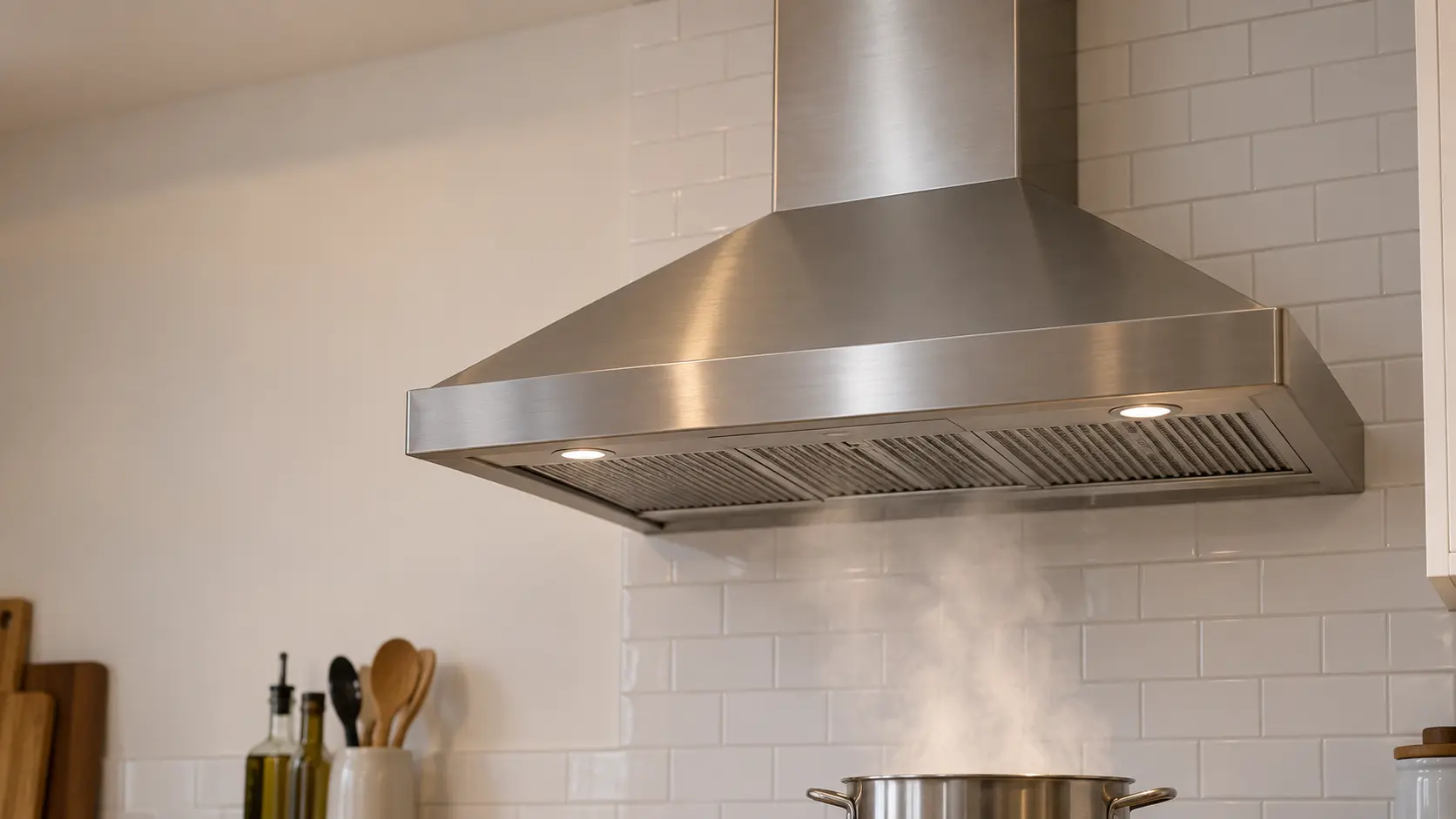
The chimney hood fixed to a bare stretch of wall above the burners, its canopy catching the rising smoke while a telescoping cover hides the duct that climbs to the ceiling.
Mon–Sat, 8am–8pm
- 4 things that fail on it
- 28 makes build it
- 6 problems it shows
Book a visit
Three short steps, about a minute.
or call (844) 398-3217
Loading appointment form…
The appointment form couldn’t load. Please try again.
Is yours
a wall-mount?
A wall-mount range hood, often called a chimney hood, hangs on brackets screwed into the wall studs with no cabinet above it. Its canopy, glass or stainless, spreads wide over the burners to catch the plume, and a two-part rectangular cover rises from its top to the ceiling so the duct and the wiring inside stay out of sight. Grease filters sit under the canopy: rolled mesh on lighter models, folded steel baffles on the pro-style ones. Behind them is the blower, either built into the canopy or moved elsewhere as an in-line fan in the attic or a remote unit on the roof, which makes the hood quieter and the diagnosis longer. The controls are a slide switch, push keys or a glass touch strip on the front edge, feeding a small board that also runs the lights. Air leaves through a backdraft damper at the top of the canopy and travels up through the ceiling or straight back through the wall to a cap outside. Because so much of it hides in the cover, a visit reads the symptoms from below before any trim comes off.
 What fails on a wall-mount range hood
How to tell
Nothing but wall and tile sits above the canopy: a narrow rectangular cover climbs straight from its top to the ceiling.
The canopy flares wider than its chimney, like an upside-down funnel, and its lower edge sits roughly at forehead height over the burners.
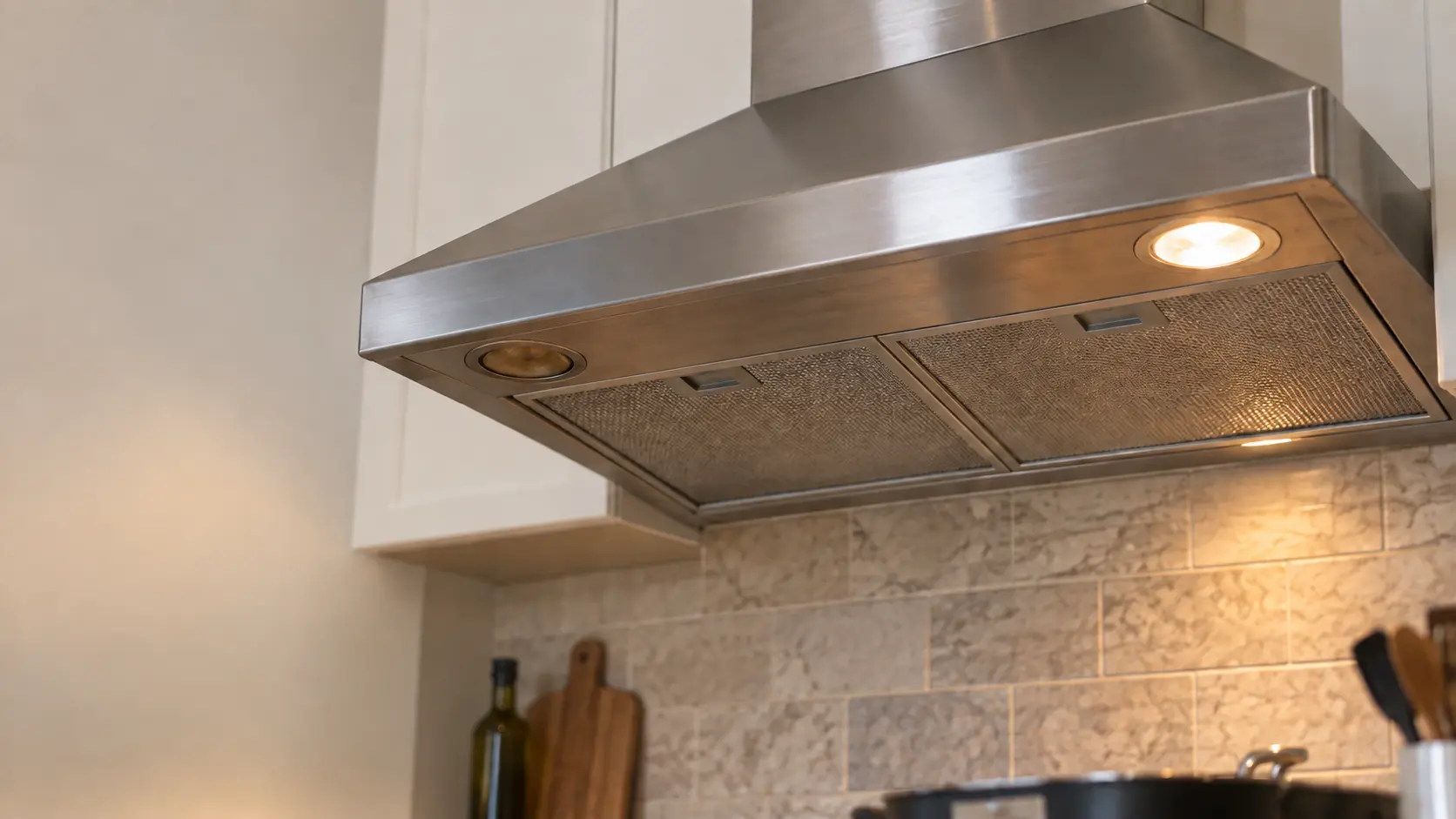
Looking up from below shows two to four removable filters, often folded steel baffles, with a pair of lamps set between them.
The hood has no cabinet doors around it; its weight rests on brackets behind the canopy that you cannot see from the room.
Not yours?Under-cabinet range hoodIsland range hoodRange hood insert
What fails
on this design.
On a wall-mount range hood: blower bearings or the start capacitor, a damper that sticks shut or flaps, touch keys and the board behind them, lamps and the transformer that feeds them.
The problems it showsBlower bearings or the start capacitor
A chimney hood's fan runs through years of steam and grease, and its bearings dry out first: a growl on high speed, then a slow start, then a hum with no spin. A tired start capacitor makes the same hum, which is why the two are measured apart before a motor is ordered.
A damper that sticks shut or flaps
The light metal flap at the top of the canopy is meant to swing open with the airflow and fall closed when the fan stops. Grease glues it half shut, which starves the hood, or its hinge wears loose and it clatters in every gust against the outside cap.
Touch keys and the board behind them
Heat and steam rise past the front edge every time a pot boils, and the keypad or glass touch strip sits right in that path. A key that needs a hard press, a fan that runs at one speed only, or lights that blink on their own usually trace to the key panel or its board.
Lamps and the transformer that feeds them
Halogen lamps burn out and blacken their sockets; the low-voltage transformer or LED driver that powers them can quit with every bulb still good. Replacing one lamp after another without checking the supply is how owners spend money on the wrong part.
Getting at it,
and whether to.
Filters, lamps, the keypad and the canopy's underside are reached from the floor or a short step, so most chimney hood work begins without touching the cover above.
What repairs costOn the visit
- The telescoping chimney cover lifts or slides off only once the screws at its base are out; the technician does that, because the wiring and the duct connection sit right behind it.
- Please do not climb inside the chimney cover or reach toward the blower wiring before the visit; turning the hood off at its switch and the breaker is all it needs from you.
- A remote or in-line blower may be in the attic or on the roof, so tell us if you know where the fan is and how that space is reached.
Repair or replace
A chimney hood is worth repairing in most cases, because a new one rarely matches the old bracket holes, the duct position or the tile cut around the cover, and a bigger canopy can mean a different duct size. Filters, lamps, a damper, a capacitor and a switch are small jobs. A blower motor or a control board on a well-made hood is usually still the better choice than replacing it; on a light entry-level canopy past fifteen years, with a board that is no longer made, the technician gives you both routes before you decide.
Book a visit for a wall-mount range hoodThe problems
it shows.
On a wall-mount range hood, most often range hood fan not working at any speed.
All problems
Range Hood Fan Not Working at Any Speed
6 causes, cheapest first

Range Hood Runs but Barely Pulls Smoke
7 causes, cheapest first

Range Hood Too Loud: Roar, Whine or Grinding
6 causes, cheapest first
Range Hood Lights Out or Flickering
6 causes, cheapest first

Cold Draft or a Flapping Damper Through the Range Hood
6 causes, cheapest first

Range Hood Pulling Away From the Wall or Ceiling
6 causes, cheapest first
Who builds
a wall-mount.
28 of the makes on this site build a wall-mount range hood. Each mark opens that make's own page.
All 29 brandsWall-mount range hood repair,
where we come out.
9 metros, each with its own page.
All service areasTampa BayFL · 31 areas
Miami / South FloridaFL · 47 areas
New York MetroNY · 75 areas
HoustonTX · 36 areas
ChicagoIL · 50 areas
Los AngelesCA · 95 areas
San DiegoCA · 31 areas

Questions about
wall-mount range hoods.
Why does my chimney hood pull less air than it did when it was new?
Can a wall-mount range hood blow its air straight through the wall behind it?
Is the telescoping cover above my hood safe for me to take off?
My hood has a remote blower on the roof. Is that fan something you work on too?
Back to your everyday
Is it a wall-mount range hood?
Say so when you book — it changes what the technician brings and how the visit is planned.