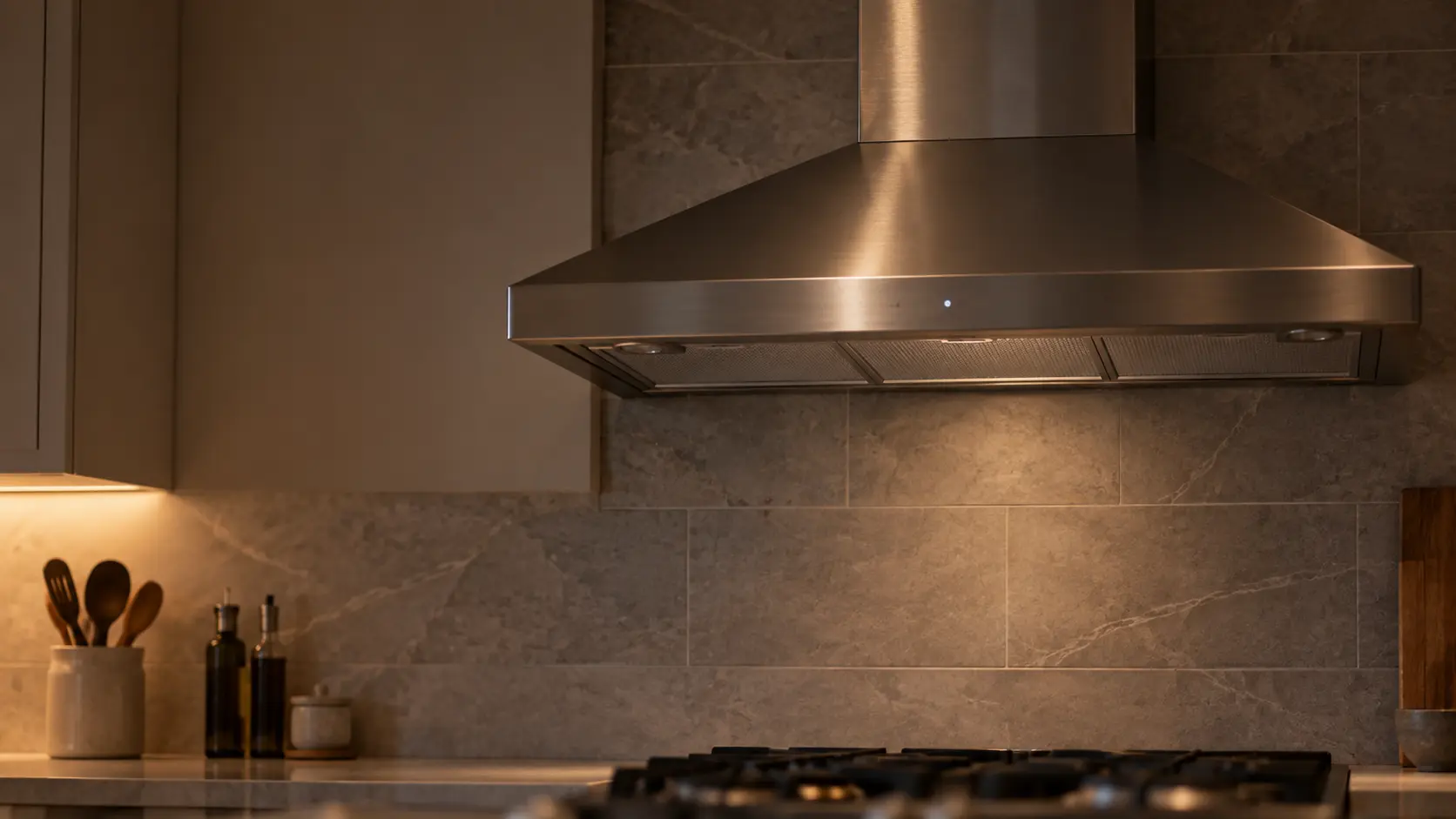
A heat sensor doing its job
When a range hood fan turns on by itself, the first suspect is a thermostat in the canopy that watches the temperature right above the burners. Broan calls its version Heat Sentry: when it detects excessive heat it turns the blower on high, and once the temperature is back to normal the fan shuts off or returns to whatever speed you had chosen. It exists to protect the hood itself, not to clear smoke.
The trigger is usually obvious once you know to look for it: a large pot boiling hard on the front burners, a pan searing with the hood off, or the oven door below vented upward after a long bake. The fan starts, sometimes a minute after the heat began, and will not respond to the off key until the canopy cools.
- Fan started while a burner was on high: the heat sensor, working as designed.
- Fan started with everything cold: note the time and the speed, then book.
- Fan ignores off but stops once the canopy cools: normal protection.
What the sensor does on a touch-control hood
Broan's BQLA1 series shows the logic in detail. When the sensor trips with the blower already running, the hood drops or raises the fan to medium and every blower key blinks; you can still work the lights. If the heat is extreme it shuts the blower and lights off, the keys blink faster, and the fan comes back on medium only after the canopy has cooled.
When the sensor itself is the problem
A thermostat that has drifted or stuck closed will start the fan with the burners cold, often at the same speed every time. If the fan runs on a cool morning with nothing cooking, and switching the hood's breaker off and on does not clear it, the sensor or its wiring needs checking, which is a heat sensor repair.
Source: Broan-NuTone — Why does the fan in my range hood turn on by itself? — Heat Sentry turns the blower to high when excessive heat is detected; when the temperature is normal the fan shuts off or returns to the previous setting
A delayed shut-off still counting down
Delay-off is meant to keep clearing the air after the cooking ends, and it is easy to set by accident. On Broan's BQLA1 series, holding the lit speed key for three seconds starts a ten-minute run and that key blinks until time is up; Zephyr's Firenze uses a separate key, runs fifteen minutes and shows a flashing dot in the corner of its display.
Ending the timer early
If the fan keeps going after you press off and then stops by itself about ten or fifteen minutes later, you have found the reason. Both makers let you end the timer early: Broan with another three-second hold on the blinking key or a touch of the master key, Zephyr by switching the blower off. Nothing is broken, and nothing needs resetting afterward.
Source: Broan-NuTone — BQLA1 and NQLA1 range hood installation, use and care manual — Heat Sentry sets the blower to medium with all blower sensors blinking, and on excessive heat shuts blower and lights off with a faster blink; delay-off is a 3-second hold on the lit speed key for a 10-minute run; the control is light-sensitive and an external light source can falsely activate it; Zephyr — Firenze ZFI-M90S use, care and installation guide — Delay off shuts the blowers down 15 minutes after it is activated, shown by a flashing dot on the display

A hood linked to the cooking surface
Some newer hoods pair with a matching cooking surface by radio or Wi-Fi so the fan starts and changes speed when a burner is turned on. If you moved into a house with such a pair, or a pairing was set during installation, the hood will seem to act on its own every time someone cooks. The owner's manual for the hood explains how to switch the link off or on; nobody needs to open anything to do it.
A linked hood can also keep running for a while after the burners are off, the same way a delay-off timer does. Check the display for a link or automatic symbol before assuming the controls have failed.
Touch keys, sunlight and moisture
Broan includes an unusual note with one of its touch controls: the keypad is light-sensitive, pointing directional spotlights at it may make it misbehave, and in rare cases an outside light source can falsely switch it on. If the fan starts at the same time on sunny afternoons, or right after someone turns on a track light aimed at the hood, that note is worth remembering.
Steam and grease on a touch strip can do something similar. A film of moisture across two keys may register as a press. Wipe the panel dry with a soft cloth, let the hood sit off for a minute, and see whether the phantom starts stop.
- Starts in strong sun or under a new spotlight: try shading the keypad for a day.
- Starts after a steamy boil: dry the keypad and watch again.
- Starts at random with a dry keypad in the dark: likely the switch or control board.
Source: Broan-NuTone — BQLA1 and NQLA1 range hood installation, use and care manual — Heat Sentry sets the blower to medium with all blower sensors blinking, and on excessive heat shuts blower and lights off with a faster blink; delay-off is a 3-second hold on the lit speed key for a 10-minute run; the control is light-sensitive and an external light source can falsely activate it
Switches and boards that stick on
If none of the features explains it, the control itself is the suspect. On a hood with slide or rocker switches, a switch whose contacts have welded shut keeps the fan running whatever position the lever is in. On an electronic hood, a relay on the control board can stick closed in the same way, and a board damaged by heat or moisture can start the fan at any speed.
One power reset is fair: turn the hood's breaker off, wait a full minute, and turn it back on. If the fan starts again straight away, or the reset clears it for only a day, leave the breaker off if you need silence and book a controls visit. A fan that cannot be switched off is also a fan that could run unattended for hours.